Mindful Communication for Emotional Clarity (4-Step Check)

Calm Words, Clear Feelings: A Practical Guide to Emotional Clarity and Mindful Communication
Emotional clarity makes it easier to speak with steadiness, set boundaries without guilt, and repair misunderstandings before they grow. This guide focuses on simple, repeatable communication habits that reduce reactivity and help feelings become understandable—both internally and in conversation—so words land with more care and less confusion.
What Emotional Clarity Looks Like in Real Life
Emotional clarity isn’t about sounding perfect. It’s about knowing what’s happening inside you well enough to communicate it without escalating the moment.
- Noticing the difference between a feeling (sad) and a story (they don’t care about me).
- Being able to name what’s happening without escalating: “I’m overwhelmed” vs. “You always do this.”
- Holding two truths at once: caring about someone and still needing a boundary.
- Recognizing when the goal is understanding, not winning.
- Using a slower pace—pauses, shorter sentences, and fewer assumptions.
One practical signal of clarity: your words stay specific. Instead of trying to “prove” your feelings, you describe what you noticed, what you felt, and what you need next.
Why Words Get Sharp When Feelings Are Unclear
When emotions are vague, the brain tends to fill in the gaps with urgency, blame, or defensiveness—especially under stress. The body’s stress response can narrow attention and push communication toward quick conclusions.
- Stress response can narrow attention and push communication toward blame, urgency, or avoidance (see American Psychological Association — Stress effects on the body).
- Unmet needs often show up as irritation, sarcasm, or withdrawal when they are hard to name directly.
- Common “hidden feelings” that disguise themselves: hurt as anger, fear as control, shame as defensiveness.
- The role of cognitive distortions in conflict: mind-reading, catastrophizing, all-or-nothing conclusions.
- A quick reset helps: hydration, a few slow exhales, and a short break before replying (additional coping tools: National Institute of Mental Health — Coping with stress).
Mindfulness helps because it trains attention to notice what’s happening without instantly acting it out. If “mindful” sounds abstract, think of it as a short pause that creates choice (learn more: Greater Good Magazine (UC Berkeley) — What is mindfulness?).
A Simple 4-Step Clarity Check Before Speaking
When the conversation matters and the stakes feel high, a fast “clarity check” can turn a reactive sentence into a usable request.
- Step 1 — Name the emotion: choose one word first (frustrated, worried, disappointed, lonely).
- Step 2 — Locate it in the body: tension, heat, heaviness, tight throat, restless hands.
- Step 3 — Identify the need: rest, respect, reassurance, autonomy, support, time, clarity.
- Step 4 — Choose the request: one actionable ask that fits the moment and is measurable.
If the request can’t be made yet, choose a boundary that protects the connection: “I need a pause; I’ll return to this at 6.”
From reaction to request: quick translations
| In the moment | Clear feeling | Underlying need | Calm request |
|---|---|---|---|
| “You never listen.” | Unheard, frustrated | To feel understood | “Can you repeat what you heard me say before you respond?” |
| “Whatever, it’s fine.” | Hurt, disappointed | Repair or reassurance | “I’m not fine yet. I’d like to talk after a short break.” |
| “Stop doing that right now.” | Anxious, overwhelmed | Safety or predictability | “Can we slow down and take one step at a time?” |
| “You’re being selfish.” | Lonely, resentful | Consideration, partnership | “Can we split this task and check in on what feels fair?” |
Mindful Communication Skills That Prevent Escalation
Once you can name what’s happening, these small skills keep conversations from turning into a courtroom.
- Use “I” statements that include impact and request: “I feel __ when __; can we __?”
- Reflect before responding: summarize what was heard in one sentence.
- Ask permission before feedback: “Are you open to hearing something?”
- Replace absolutes (always/never) with specifics (yesterday/this week/when X happens).
- Choose one topic at a time; “stacking” issues increases defensiveness.
- End with a next step: a plan, a check-in time, or an agreed pause.
A useful rule: if your sentence contains a diagnosis of the other person’s character, rewrite it as an observation plus impact. “You’re selfish” becomes “When plans change last-minute, I feel unconsidered, and I need more notice.”
Calm Expression in High-Stakes Moments (Work, Family, Relationships)
Using the Calm Words, Clear Feelings Digital Guide as a Daily Practice
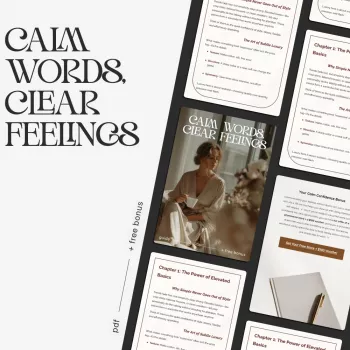
If a ready-to-use framework helps, Calm Words, Clear Feelings — Emotional Clarity Guide | Mindful Communication eBook is designed for quick, repeatable practice—especially when you know you want to communicate better but don’t want a complicated system.
For related growth in social ease and self-expression, Quiet Confidence — A Growth-Focused Introvert’s Guide to Social Ease complements communication work by strengthening confidence and pacing in everyday interactions.
And for couples who want more connection outside of heavy talks, Creative Hobby Date Ideas That Bring You Closer offers simple shared activities that can make serious conversations feel less like the only time you “connect.”
When to Pause and Get Extra Support
FAQ
How is mindful communication different from just “being nice”?
Mindful communication includes clarity, boundaries, and accurate emotion naming—not just politeness. Kindness without clarity can become avoidance, while mindful communication stays respectful and direct about what’s true and what’s needed.
What can be said when emotions are high but the conversation needs to continue?
Use short scripts that slow the pace: “I’m getting overwhelmed—can we take two minutes to breathe and then continue?” or “I’m feeling anxious; I need one clear next step—can you tell me what you want from me right now?” Keep it brief and focus on regulation over persuasion.
Is this digital download suitable for beginners who struggle to name feelings?
Yes—starting with one-word emotions and simple prompts makes it beginner-friendly. Over time, it becomes easier to build a small feelings vocabulary and turn vague discomfort into a specific, calm request.















Leave a comment