Fear of Failure Reset: Build Confidence With Small Reps

Overcoming the Fear of Failure: A Practical Mindset Reset for Confidence and Follow-Through
Fear of failure rarely announces itself as “fear.” It’s more likely to show up as procrastination, perfectionism, over-preparing, or staying busy without shipping anything that can be judged. The good news: confidence doesn’t come from never messing up—it comes from learning how to recover quickly, regulate stress in the moment, and take the next small step even when outcomes feel uncertain.
This practical reset breaks fear of failure into workable parts—thought patterns, nervous-system responses, and skill gaps—so follow-through becomes something you practice, not something you wait to “feel ready” for.
What Fear of Failure Really Looks Like (and Why It Feels So Convincing)
Fear of failure often hides behind “responsible” behaviors: planning, researching, tweaking, and waiting for the perfect time. These can be helpful—until they become a way to avoid the risk of being seen.
- Common masks: procrastination, over-planning, avoidance of feedback, quitting early, and perfectionism that delays shipping anything “imperfect.”
- Hidden beliefs: “If I fail, it means I’m not capable,” “People will judge me,” or “One mistake will ruin everything.”
- The brain’s efficiency bias: the mind prefers certainty and safety, so it exaggerates risk and minimizes the learning value of trying.
- Confidence misconception: confidence is treated like a prerequisite, but it’s usually the result of repeated reps and recoveries.
Fear pattern to practical response
| Fear pattern | What it sounds like | Helpful response |
|---|---|---|
| Perfectionism | “If it’s not flawless, it’s pointless.” | Define “good enough,” set a deadline, ship a minimum viable version. |
| Procrastination | “I’ll start when I feel ready.” | Start with a 10-minute action; readiness follows motion. |
| Avoiding feedback | “Criticism will prove I’m not good.” | Seek one specific input (clarity, structure, outcome) rather than global judgment. |
| All-or-nothing thinking | “If I can’t do it perfectly, I shouldn’t do it.” | Break into small experiments; measure progress, not identity. |
| Catastrophizing | “If I fail, everything falls apart.” | List realistic outcomes and recovery steps; plan a “next move” for each. |
The Confidence Loop: Action → Evidence → Self-Trust
Confidence grows through evidence. When you take a small action, you create proof that you can move—even with imperfect feelings. That proof builds self-trust, and self-trust makes the next action easier.
- Use micro-commitments: choose actions that are too small to avoid (send one email, draft one paragraph, practice 5 minutes).
- Track kept promises: log daily follow-through, even when results are messy; consistency builds identity-level trust.
- Separate performance from worth: results can be improved; personal value doesn’t fluctuate with outcomes.
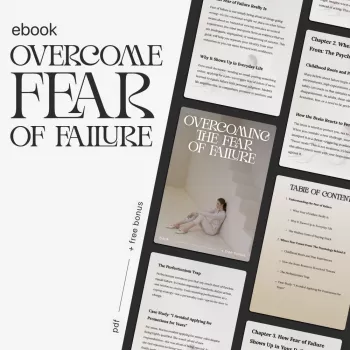
If you want structure instead of willpower, a guided option like Overcoming the Fear of Failure | Digital eBook for Mindset Growth | Learn How to Overcome Fear of Failure and Build Confidence can turn these ideas into repeatable daily reps.
A Simple Reframe: From “Failing” to “Running Experiments”
One of the fastest mindset shifts is to treat goals like experiments. When your goal is “data collected,” your nervous system doesn’t have to carry the same identity-level pressure.
- Define the hypothesis: “If I practice X for 14 days, I will improve Y.”
- Limit variables: change one thing at a time so progress is measurable and less emotionally loaded.
- Adopt a review rhythm: weekly reflection on what worked, what didn’t, and the next smallest adjustment.
This approach aligns with a growth mindset: skills are built through effort, feedback, and iteration—not proven in a single attempt. For a deeper foundation on this idea, see Stanford’s overview of Carol Dweck’s growth mindset.
How to Calm the Stress Response So You Can Think Clearly
If anxiety feels constant or disruptive, it may help to review what clinical anxiety can look like via the National Institute of Mental Health (NIMH) overview on anxiety disorders.
Practical Skills That Reduce Fear: Planning for Recovery, Not Perfection
Even your environment can support recovery. A clearer workspace reduces overwhelm and decision fatigue, making it easier to begin. If visual clutter tends to derail you, Storage Hacks to Reduce Visual Clutter | Printable Checklist for Home Organization, Decluttering Guide & Minimalist Storage Ideas (Digital Download) can help you set up a calmer “start zone” that makes follow-through more automatic.
When Fear of Failure Comes From Environment, Not Mindset
Resilience is learnable, especially when you build coping tools before the next challenge hits. The American Psychological Association (APA) guide to resilience offers a helpful overview of what supports recovery and adaptability.
A Guided Resource for Mindset Growth and Confidence-Building
- Look for a step-by-step format with exercises, prompts, and quick routines that reduce overthinking.
- Choose a pace that supports daily follow-through, not occasional “big motivation.”
- Recommended option: Overcoming the Fear of Failure | Digital eBook for Mindset Growth | Learn How to Overcome Fear of Failure and Build Confidence.
FAQ
How long does it take to overcome fear of failure?
Fear usually decreases through repeated small exposures and recovery experiences. Many people notice meaningful shifts in 2–4 weeks with consistent practice, though timelines vary based on stress level, support, and how high-stakes the situation feels.
What if fear of failure is tied to perfectionism?
Set “good enough” criteria, timebox your work, and ship smaller versions more often to build evidence that imperfect progress is still progress. Track kept commitments (not flawless outcomes) and practice separating identity from performance.
How do you rebuild confidence after a real failure?
First decompress, then extract lessons without self-attack, choose one controllable next action, and rebuild evidence through small wins. If the setback was traumatic or the distress persists, getting support can speed recovery and protect your momentum.















Leave a comment