Mental Reset Routine: 30-Second to 10-Minute Calm Plan
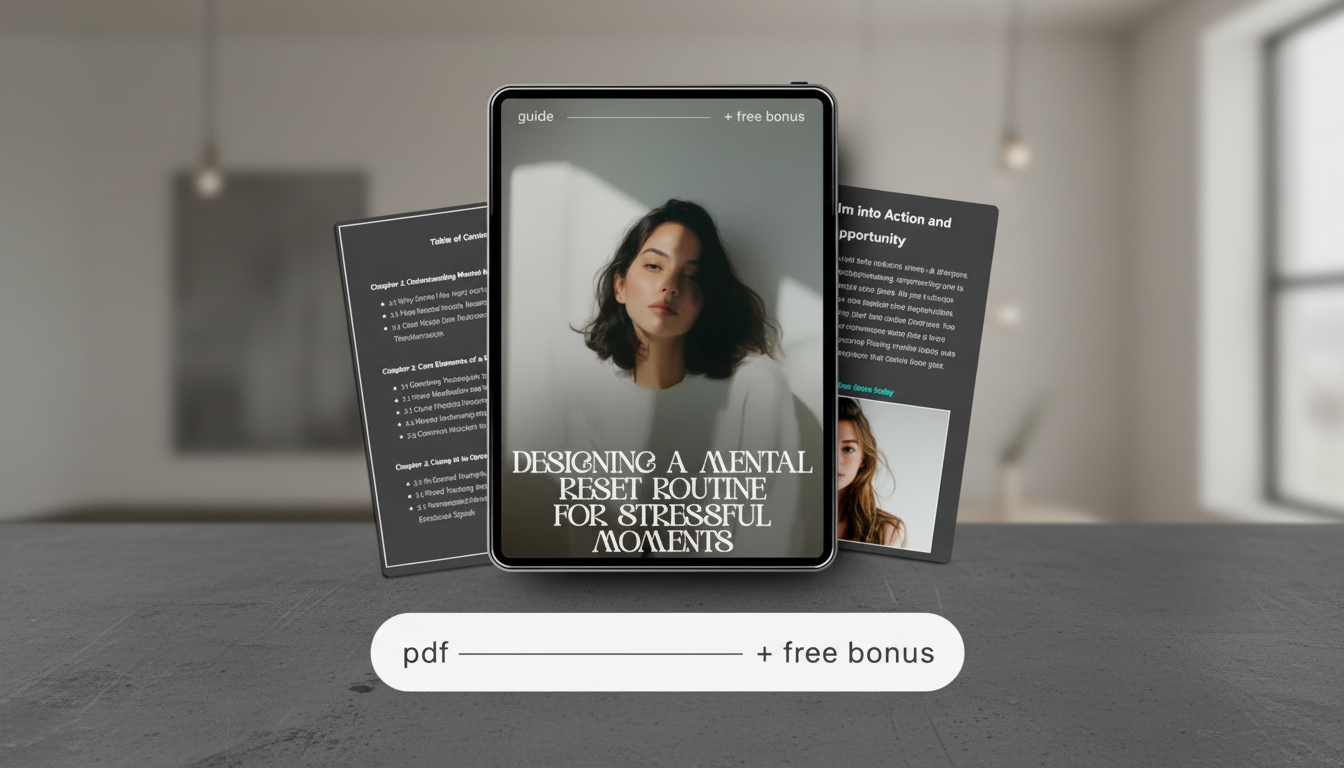
Designing a Mental Reset Routine for Stressful Moments
Stressful moments can arrive fast—an email, a tough conversation, a sudden change of plans. A mental reset routine is a short, repeatable sequence that interrupts the stress spiral, settles the nervous system, and helps thinking become clear again. The goal isn’t to erase stress, but to regain steadiness and choose the next best step.
What a “mental reset” really does (and what it doesn’t)
A mental reset is a deliberate pause between a trigger and a reaction. That pause matters because it creates room for a calmer choice—especially when the body is running a threat response and the mind is rushing toward worst-case scenarios.
- It creates space. You stop the reflex to fire off a reply, defend yourself, or “fix it now,” and regain the ability to respond on purpose.
- It downshifts stress physiology. Breath, attention, and sensory cues can signal safety and reduce the intensity of the stress response.
- It returns you to the present. A reset helps bring attention back to what’s happening right now, not what might happen next.
- It doesn’t solve the whole problem instantly. It supports clearer thinking and better communication after you reset.
- It works best when practiced ahead of time. Repetition during low-stress moments makes the routine easier to access when pressure is high.
For a quick definition of stress and how it shows up psychologically, the APA Dictionary of Psychology is a helpful reference point. For practical, plain-language context on stress, the National Institute of Mental Health offers a concise overview.
Spot the early signals and pick a reset “trigger”
The most effective routines start early—before stress escalates into snapping, shutting down, or spiraling. Think of your signals as an early warning system, not a personal flaw.
- Body signals: tight jaw, shallow breathing, clenched hands, stomach drop, shoulder tension, headache pressure.
- Mind signals: looping thoughts, catastrophizing, irritability, blanking out, urgency to “fix it now.”
- Behavior signals: snapping, withdrawing, doom-scrolling, overexplaining, rushing, procrastinating.
Next, choose one clear trigger that starts the routine. Make it specific and easy to notice: “When I notice my breath get shallow,” “When I reread the same message twice,” or “When my heart rate spikes.”
Finally, add a simple label. Naming the state reduces intensity and adds distance: “This is stress,” “This is overwhelm,” or “This is a threat alarm.” The goal is not to judge it—just to recognize it.
Build a routine that fits the moment: 30 seconds, 3 minutes, or 10 minutes
Consistency beats complexity. When stressed, the brain does not want a menu with ten options; it wants a familiar sequence. Keep the same steps in the same order so the routine becomes automatic.
A practical approach is to create three versions that share the same “spine,” then expand based on time:
- Micro (30–60 seconds): subtle enough for meetings, public spaces, and quick interruptions.
- Standard (2–4 minutes): ideal before responding to messages or moving into a difficult task.
- Extended (8–12 minutes): best after conflict, at the end of a tough day, or when decision fatigue is high.
Use stackable steps: begin with breath, add grounding, add reframing, then choose one next action. Avoid anything that requires special equipment; rely on breath, posture, touch, and attention. End with a clear re-entry phrase—“Next step: ___”—so the reset doesn’t become avoidance.
| Time | Steps (in order) | When to use | Quick note |
|---|---|---|---|
| 30–60 seconds | Exhale longer than inhale (3 cycles) → relax shoulders → name 3 things seen | In a meeting, on a call, in public | Prioritize subtle steps that don’t draw attention |
| 2–4 minutes | Box breathing or paced breathing → 5-4-3-2-1 grounding → “What’s true right now?” | Before replying to a message, after a mistake, before driving | Aim for steady breathing, not “perfect calm” |
| 8–12 minutes | Breathing → body scan → brief journaling (3 prompts) → choose one task | After conflict, end of a hard day, decision fatigue | Include reflection only when time allows |
Step-by-step: a practical 4-part reset sequence
This sequence is designed to be repeatable, portable, and fast. Use it as your default “script,” then adjust details over time.
1) Regulate (60–90 seconds)
Breathe out slowly. Try a 4–6 rhythm: inhale for 4, exhale for 6, for 6–8 cycles. Longer exhales are a simple way to nudge the body toward settling.
2) Ground (30–60 seconds)
3) Reframe (30–90 seconds)
4) Re-enter (15–30 seconds)
Customize for common high-stress moments
Make it stick: practice, cues, and recovery habits
A guided option to follow when the mind is too busy to plan
- Designing a Mental Reset Routine for Stressful Moments (digital download)
- Quiet Confidence — A Growth-Focused Introvert’s Guide to Social Ease (digital eBook & checklist)
FAQ
How long should a mental reset routine take?
It can be as short as 30–60 seconds or as long as 10 minutes, depending on the situation. Consistency matters more than length, and starting with a 60-second version makes it easier to use anywhere.
What if the routine doesn’t work in the moment?
Stress has momentum, so one pass may not fully settle things. Repeat the first step (longer exhales), switch to stronger grounding (orientation to the room), and use a boundary/pause if needed—then keep practicing during calm times so the routine is easier to access under pressure.
Can a mental reset routine help with anxiety at work or during conflict?
Yes—especially when you use discreet breath and grounding steps that fit the setting. It won’t fix the entire situation instantly, but it can help you respond more clearly, communicate with less heat, and choose a calmer next action.
















Leave a comment