Weekly Reset Routine: Reflect, Realign, and Rise
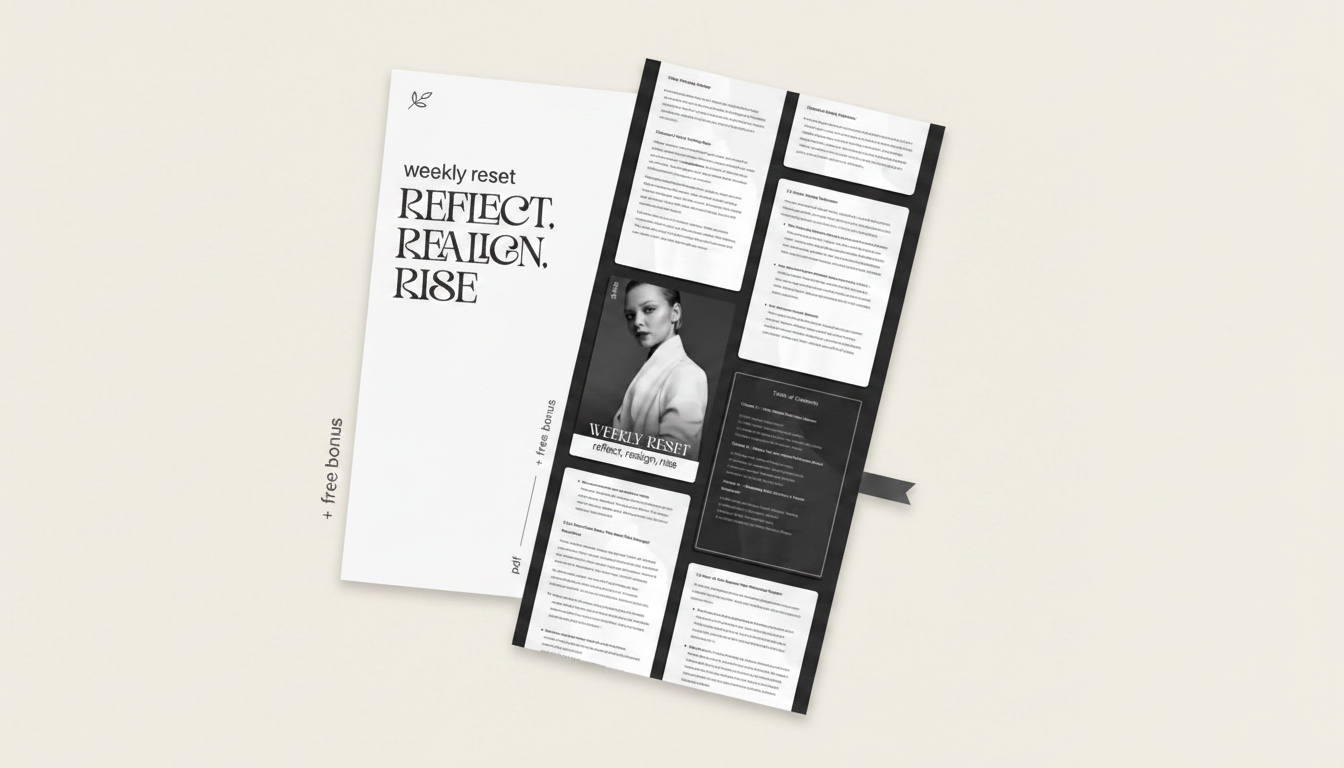
Weekly Reset: Reflect, Realign, Rise — A Simple Guided Routine for Ending the Week Strong
A weekly reset turns scattered days into a clear story: what worked, what didn’t, and what to do next. With a short, repeatable reflection routine, it becomes easier to notice patterns, reduce mental clutter, and begin the next week with priorities that match real life. This guide lays out a practical structure for reflecting on the week effectively—plus a guided workbook option for anyone who wants prompts ready to go.
Journaling and structured reflection are also linked with emotional clarity and stress support in research and practice, including resources from the American Psychological Association and Greater Good Magazine (UC Berkeley).
What a weekly reset actually does
A weekly reset isn’t about “fixing” yourself. It’s a closing ritual for one chapter and a calm start for the next—so your plans reflect reality instead of wishful thinking.
- Creates a clean transition: closes the current week before starting the next one.
- Builds self-awareness: highlights habits, triggers, and energy drains that are easy to miss day-to-day.
- Strengthens follow-through: turns vague goals into specific next actions.
- Reduces rumination: gives worries a container and a plan.
- Supports balance: makes space to acknowledge wins alongside challenges.
The 20–30 minute weekly reflection flow
This routine is designed to feel doable even when the week was messy. Keep it simple, repeat it weekly, and adjust the timing as needed.
Step 1 — Set the scene (2 minutes)
Put the phone away, grab a notebook or workbook, and choose one small ritual (tea, music, candle) to signal “reset time.” The goal is to arrive mentally, not to create a perfect atmosphere.
Step 2 — Rewind the week (5 minutes)
Skim your calendar, photos, messages, or notes to capture what actually happened rather than what is most emotionally loud. A factual rewind prevents one hard moment from rewriting the entire week.
Step 3 — Name the highlights (5 minutes)
List 3 wins (big or small), 1 moment of pride, and 1 thing learned. This trains your brain to notice progress, not just problems.
Step 4 — Notice friction (5 minutes)
Identify the top 1–2 stressors, what triggered them, and what helped (or could have helped). Keep it practical: you’re not putting yourself on trial—you’re gathering useful data.
Step 5 — Realign priorities (5 minutes)
Choose 1–3 focus areas for next week that match capacity (time, energy, season of life). Alignment means your priorities fit your actual bandwidth.
Step 6 — Decide next actions (5 minutes)
Write 3 concrete actions and schedule the first one. If it isn’t calendar-worthy, it’s usually too vague.
Step 7 — Close the loop (2–3 minutes)
End with a short gratitude line and a simple intention (one sentence). Think of it as a gentle “handoff” to next week.
| Phase | Time | Prompt | Output |
|---|---|---|---|
| Settle | 2 min | What do you need to feel present? | Calm starting point |
| Rewind | 5 min | What happened this week—factually? | Quick timeline |
| Reflect | 10 min | Wins, lessons, hard moments | Patterns + insights |
| Realign | 5 min | What matters most next week? | 1–3 priorities |
| Rise | 5 min | What are the next three actions? | Scheduled steps |
Questions that lead to useful answers (not just venting)
It’s easy for reflection to turn into a replay loop. These question tweaks keep the tone honest, kind, and action-oriented.
- Keep it specific: replace “Why am I like this?” with “What happened right before I felt stuck?”
- Balance truth with kindness: pair a challenge with a support question (e.g., “What made this hard?” + “What would make this 10% easier?”).
- Focus on controllables: choose one change you can make, one request you can voice, and one boundary you can reinforce.
- Look for repeat patterns: energy dips, conflict themes, overcommitting, procrastination cues, or times of flow.
- End with forward motion: every reflection should produce at least one small next step.
Common obstacles—and quick fixes
- “There’s no time.” Fix: do a 10-minute version with only: 1 win, 1 lesson, 1 priority, 1 next action.
- “I get overwhelmed by everything I didn’t do.” Fix: start with wins first, then choose only one improvement area.
- “I don’t know what to write.” Fix: use structured prompts and sentence starters to avoid blank-page stress.
- “I reflect but nothing changes.” Fix: add a scheduling step—put the first action on the calendar before finishing.
- “I’m too hard on myself.” Fix: include a compassion check: what would be said to a friend in the same situation?
Using a guided workbook to stay consistent
If you want prompts ready to go, consider Weekly Reset: Reflect, Realign, Rise | Guided Reflection Workbook. It’s designed to make the weekly reset feel like a repeatable routine rather than another project.
And if social situations are a recurring stressor in your weekly reflection—work conversations, networking, small talk, or speaking up—Quiet Confidence — A Growth-Focused Introvert’s Guide to Social Ease can pair well with your reset by turning one common “friction theme” into a skill-building plan.
Make it stick: a simple weekly ritual
FAQ
How long should a weekly reflection take?
A practical range is 20–30 minutes, but a 10-minute reset can work on busy weeks. Consistency matters more than duration, as long as you end with at least one clear next step.
What should be included in an effective weekly reset?
Include a quick review of what happened, a few wins, lessons learned, challenges or stressors, next week’s priorities, and 1–3 concrete next actions. Close with a short intention or gratitude line to mentally “seal” the week.
When is the best time to do a weekly reset?
Common options are Sunday evening, Monday morning, or Friday end-of-day. The best choice is the one you can repeat reliably, ideally tied to an existing routine so it becomes automatic.















Leave a comment