5-Year Career Plan Template: Skills, Proof & Monthly System

Career Map: A Practical 5-Year Career Plan for Professionals, Graduates, and Career Changers
A five-year plan works best when it’s concrete enough to guide weekly decisions and flexible enough to adapt to new opportunities. The goal isn’t to predict a perfect future job; it’s to create a system that keeps your skills, proof of impact, and next steps moving forward—so progress is visible and measurable. Below is a practical framework to set direction, reverse-engineer milestones, build credibility, and run the plan month by month.
What a 5-year career plan should include (and what to skip)
A strong plan is less about a single title and more about a repeatable path: clear direction, realistic constraints, and proof that you can deliver outcomes. Keep it simple, but specific.
- A clear career theme: the type of work you want more of (industry, role family, problems to solve) rather than one fragile job title.
- A target “next step” in 6–12 months: the bridge role, expanded scope, or project that sets up the next phase.
- Skill signals and proof: what hiring managers recognize—portfolio pieces, metrics, case studies, certifications—beyond “learning goals.”
- Constraints and non-negotiables: location, schedule, compensation needs, caregiving, health, visa requirements, and travel tolerance.
- Skip rigid timelines for what you can’t control: replace “exact promotion date” with controllable milestones and inputs.
Strong plan vs. vague plan
| Area | Vague version | Actionable version |
|---|---|---|
| Goal | Get a better job | Move into a mid-level role in a chosen function with defined responsibilities |
| Skills | Learn more | Build 2–3 job-relevant skills and produce proof (projects, outcomes, portfolio) |
| Timeline | Someday | Quarterly milestones + monthly actions |
| Networking | Meet people | 3 targeted conversations/month + follow-up system |
| Progress | Hope it works out | Track applications/interviews, projects shipped, metrics improved |
Start with direction: define your career theme in 30 minutes
If you’re unsure where to aim, don’t default to “whatever is hiring.” Start by defining a theme that’s specific enough to guide choices and broad enough to evolve.
- Inventory strengths: list tasks that feel easier than expected, repeated compliments, and work you can sustain without burnout.
- Identify motivators: autonomy, stability, creativity, leadership, helping others, complexity, mission, income.
- Choose a theme statement: “I want to do [type of work] for [who/what context] by using [core strengths].”
- Set guardrails: minimum salary range, preferred work style (remote/hybrid/on-site), travel tolerance, and time commitments.
- Write a ‘not now’ list: paths that repeatedly misalign with your guardrails (helps reduce distraction).
If you need data to sanity-check growth, pay ranges, and role outlook, the U.S. Bureau of Labor Statistics Occupational Outlook Handbook is a reliable starting point.
Reverse-engineer the destination into milestones
Years 3–5 should be described as capability and scope—not a single employer or title. That keeps you resilient when organizations, markets, and tools change.
- Define the 5-year destination as a capability level: what scope you own, decisions you make, and outcomes you consistently deliver.
- Work backward to Year 3: what you must already be doing regularly (leading projects, owning a client segment, shipping features, mentoring, technical depth).
- Work backward to Year 1: the minimum credible step that creates momentum (first role, lateral move, stretch project, certification + portfolio).
- Translate each milestone into proof artifacts: measurable results, case studies, before/after metrics, and concise stories.
- Plan for optionality: keep two plausible paths (specialist vs. manager) so a setback doesn’t stall progress.
To keep your milestones grounded in real workplace expectations, cross-check your plan against competency frameworks like the NACE Career Readiness Competencies.
Build a skill-and-proof plan that hiring managers recognize
Skill-building works fastest when every learning block ends with proof. Proof becomes resume bullets, interview stories, and internal promotion evidence.
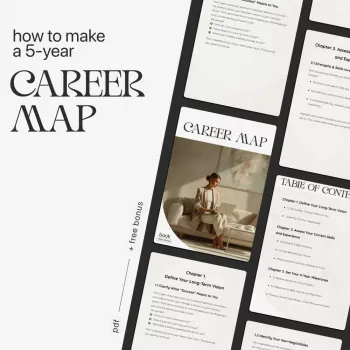
For a structured, all-in-one way to capture your theme, milestones, proof, and monthly actions, consider Career Map — Ebook Guide on How to Make a 5-Year Career Plan, a digital planner designed for professionals, graduates, and career changers.
Turn the plan into a monthly system that survives busy weeks
Environment matters for consistency. If you’re rebuilding a focused workspace for deeper work blocks, a stable surface like the 62″ Executive Desk with Double Pedestal and Natural Wood Top can make planning, portfolio work, and interview prep easier to maintain week after week.
Common forks in the road (graduates, professionals, career changers)
Using a digital career planner to keep everything in one place
If visual clutter regularly derails focus, pairing your planning system with a simple organization reset can help. The Storage Hacks to Reduce Visual Clutter | Printable Checklist for Home Organization, Decluttering Guide & Minimalist Storage Ideas (Digital Download) supports a calmer workspace so your monthly review and work blocks are easier to sustain.
FAQ
How detailed should a 5-year career plan be?
Be very clear on your direction, milestones, and the next 90 days of actions. Keep years 3–5 capability-based (scope, outcomes, leadership level) with flexible paths to reach them.
What if the plan changes after a few months?
That’s normal—change usually means you learned something useful. Use a monthly review to adjust milestones and tactics while keeping your core career theme and skill pillars stable.
How can a career changer show credibility without direct experience?
Build targeted proof: small projects that match job requirements, 2–4 portfolio pieces with measurable outcomes, and selective certifications only when they’re recognized in the field. Add credibility through volunteer work, contract projects, mentorship, or internal cross-functional work that produces results you can quantify.















Leave a comment